?Can AI Replace Medical Practitioners
Part 01
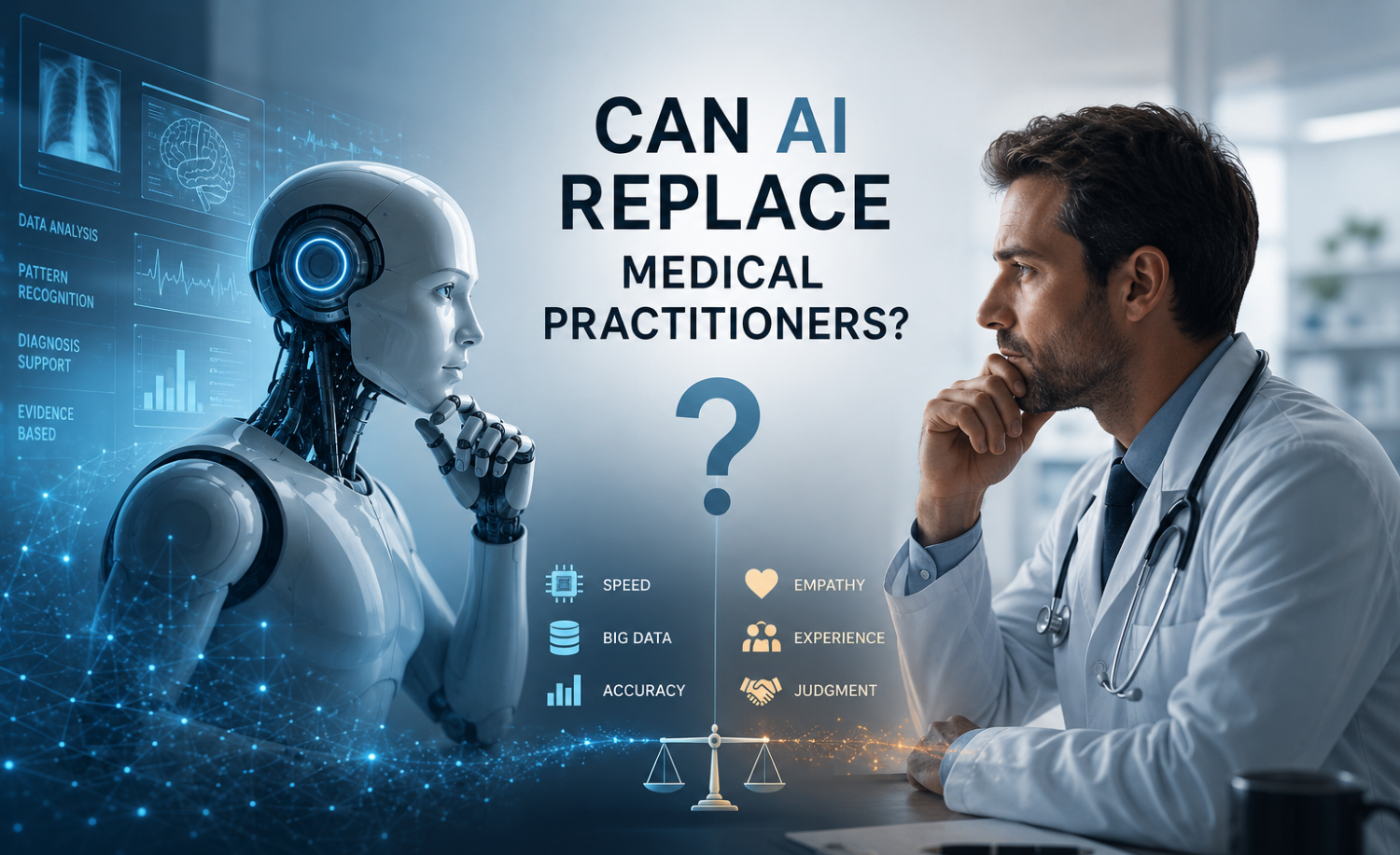
This question lies at the intersection of technology and clinical care, raising debates that are as philosophical as they are practical. To explore it meaningfully, consider the difference between an experienced emergency room (ER) physician and a novice. Their divergence is not merely academic—it reflects a wealth of clinical encounters: the patients they have seen and examined, the nuances perceived through bedside tools such as stethoscopes or point-of-care ultrasound, and the decisions made under pressure. These steps form a complex, iterative process known as Clinical Reasoning and Decision-Making (CRADM)—the heartbeat of frontline medical practice.
In this article, we examine CRADM through the lens of an ER physician and compare it with emerging AI capabilities in healthcare. By identifying both the parallels and gaps between human and machine decision-making, we aim to construct a realistic and actionable framework. This perspective is particularly valuable for non-clinician AI researchers who seek to align their work with the real-world dynamics of medicine.
Understanding Clinical Reasoning and Decision-Making (CRADM)
CRADM in the emergency room is a rapid, high-stakes process in which physicians gather, interpret, and synthesize diverse clinical inputs—patient history, physical examination, diagnostic tests, and contextual cues—to guide diagnosis, treatment, and disposition[1]. This reasoning unfolds amid uncertainty, time pressure, and incomplete information. It is not formulaic but rather probabilistic, intuitive, and shaped by experience.
Data Perception: From Human Senses to Machine Inputs
The first major divergence between human and machine cognition in medicine occurs at the level of data perception and capture. Human clinicians interpret patients through a multisensory lens—visual, auditory, haptic, and sometimes even olfactory. These perceptions are deeply embodied and form the substrate of bedside clinical reasoning.
However, when this sensory experience is translated into written documentation, critical information is lost. Phrases like “ill-appearing” [2], “abdominal tenderness”[3, 4], or “crackles”[5-7] are qualitative abstractions that vary across practitioners. Inter-rater variability and subjective thresholds make this data inconsistent and imprecise[3].
In contrast, AI systems rely on structured digital inputs—vital signs, lab results, imaging data—rather than embodied, experiential observations. Machines do not “see” or “hear” as humans do. Instead, they interpret waveforms or pixel arrays, devoid of context unless explicitly modeled.
This creates a sensory-to-digital gap where key diagnostic nuances are lost at the point of capture, not during analysis. Bridging this gap is a fundamental challenge if AI is to approximate real-world medical reasoning.
To be continued…